
19.4% verified energy saving. Zero comfort complaints. A three-year payback.
How a 175,000 sq ft Class B office in the Mid-Atlantic turned a drifted Johnson Controls Metasys Building Management System (BMS) into a self-optimizing HVAC (heating, ventilation, and air conditioning) system — without replacing a single piece of equipment.
Verified, not modeled.
Verified A/B test results from a controlled winter heating season test period. IPMVP Option B with matched test days.
Comprehensive HVAC electricity reduction across matched A/B test days, measured by dedicated sub-meter.
Calculated from the verified 19.4% rate against the 2024 baseline annual HVAC cost profile.
On a total system investment of $78,500. Continues delivering ~$9,000 net annual value after year 4.
Verified across the controlled test period with continuous indoor temperature monitoring at 1-minute resolution.
A latent BMS, turned into a working asset.
A 175,000 sq ft Class B office building in the Mid-Atlantic coastal region deployed SiteIQ's cloud-edge HVAC optimization platform to reduce energy waste in its air-source heat pump system. The building had a functional Johnson Controls Metasys BMS, but it was running on fixed schedules that had not been re-commissioned in over three years.
SiteIQ's edge controller was integrated non-invasively with the existing BMS. Using dynamic supply water temperature adjustment, intelligent equipment start/stop control, and variable differential pressure pump optimization, the system achieved a verified 19.4% comprehensive energy saving rate across a controlled A/B test period — with zero reduction in occupant comfort.
Based on verified test results and the building's 2024 baseline energy profile, estimated annual HVAC cost savings are $24,070, yielding a projected payback of approximately 3.3 years on a total system investment of $78,500.
Matched test days. Direct sub-meter measurement. 19.4%.
Daily HVAC electricity consumption across the A/B test period. Baseline days under pre-deployment manual BMS control. AI-controlled days with SiteIQ's three optimization algorithms running.
Test days paired by outdoor temperature profile (daily mean, max, min) and occupancy type. Sub-meter cross-validated against utility billing data within ±2%.
Mechanically sound. Operationally adrift.
A drifted BMS, running on autopilot.
The building's HVAC system was functional and well-maintained mechanically, but operationally inefficient. The Metasys BMS was installed during a 2018 renovation and initially commissioned with seasonal schedules and setpoints. Over the following years, however, the original control sequences had drifted: operators had overridden schedules to address tenant complaints, seasonal tuning had been skipped, and the system was effectively running in a semi-manual mode.
- Heat pumps running on fixed-temperature output, all winter
- 2 of 3 circulation pumps running 24/7 for anti-freeze protection
- Setpoints manually overridden, never re-calibrated
- ~350 low-priority alarms/week, mostly ignored
47% of the electric bill, much of it avoidable.
HVAC drove 47% of the building's total electric consumption — roughly $123,000 of the $262,000 annual electric bill. Most of that energy went into supply-temperature over-delivery, unnecessary anti-freezing pump runtime, and equipment staging that didn't match actual load.
What SiteIQ was layered on top of.
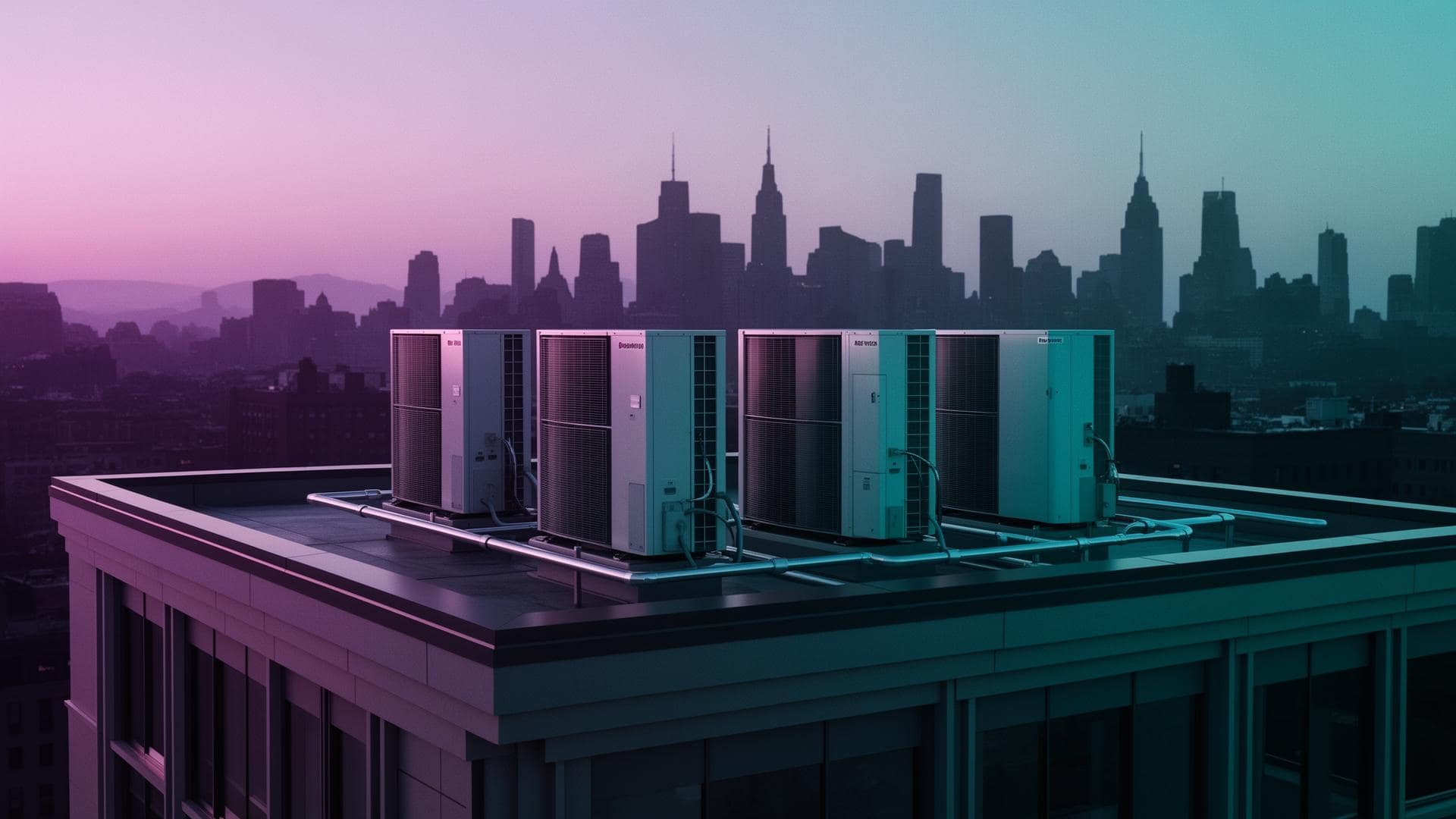
Existing HVAC plant — kept entirely in place. No mechanical equipment replaced during deployment.
| Equipment | Specification | Quantity | Rated Power |
|---|---|---|---|
| Air-source heat pumps | 65-ton each | 4 units | 260 kW total |
| Primary circulation pumps | 15 HP variable-frequency drive | 3 (2+1 standby) | 15 HP each |
| Fan coil units | Distributed across 6 floors | 52 units | Varies |
| Existing building management system (BMS) | Johnson Controls Metasys | 1 system | — |
Three algorithms, working in concert.
All running on the edge controller, all coordinated by the cloud platform, all measured against the same sub-meter.
Dynamic Supply Water Temperature Adjustment
Continuously adjusts heat pump outlet water temperature in response to indoor temperature, outdoor weather, and real-time building load. Replaces a fixed winter 95°F setpoint with a dynamic 84–95°F range.
Intelligent Equipment Start/Stop Control
Replaces 24/7 anti-freeze pump operation and fixed equipment minimums with predictive activation driven by pipeline temperature and outdoor conditions. Up to 6-hour safe shutdowns when freeze risk is low.
Variable Differential Pressure Pump Optimization
Continuous VFD modulation of circulation pump speed by differential pressure and real-time system load. Replaces manual fixed-speed bypass operation that ignored load variation.
Energy waste collapsed. Operator burden collapsed with it.
Direct measurement across paired A/B test days. Indoor environment monitored at 1-minute resolution throughout.
Driven by intelligent equipment start/stop replacing 24/7 anti-freeze operation when freezing risk is genuinely low.
On working days through dynamic load-based control and pump speed modulation.
Average daytime reduction from a fixed 95°F baseline to a dynamic 84–95°F range matched to building load.
From ~350 low-priority alarms per week to ~40 actionable alerts per week. Operator attention reclaimed.
Pays for itself in year three.
On a controlled investment, with verified ongoing savings net of software licensing.
| Item | Cost | Notes |
|---|---|---|
| Edge controller hardware | $18,500 | Industrial-grade edge computing unit with BACnet gateway |
| Sensor network & sub-metering | $12,800 | 14 wireless sensors, weather station, flowmeter, sub-meter with CTs |
| Installation & BMS integration | $22,200 | On-site labor, BACnet configuration, commissioning |
| Software license (Year 1) | $15,000 | Cloud platform, AI model training, OTA updates, remote monitoring |
| Project management & M&V | $10,000 | Deployment oversight, A/B test design, verification report |
| Total system investment | $78,500 | — |
What changed, parameter by parameter.
Side-by-side comparison of operational behavior under manual BMS control versus SiteIQ control.
Heat Pump Operation
Circulation Pump Operation
System-Level Behavior
Validation methodology
The verified energy saving rate is grounded in direct measurement rather than modeled estimates. The protocol follows IPMVP Option B and is designed to be replicable by any third-party M&V firm. This methodology is consistent with American Society of Heating, Refrigerating and Air-Conditioning Engineers (ASHRAE) Guideline 14 and can support third-party certification for utility incentive programs, ENERGY STAR benchmarking, and environmental, social, and governance (ESG) reporting.
- 01Install dedicated HVAC sub-meter with split-core current transformers on the HVAC distribution panel, separately metering heat pump units and circulation pumps.
- 02Establish baseline by operating the system under pre-deployment manual BMS control for matched test days, with all AI algorithms disabled.
- 03Operate under SiteIQ intelligent control for alternating matched test days, with all parameters logged at 1-minute intervals.
- 04Pair test days by outdoor temperature profile (daily mean, daily max, daily min) and occupancy type (weekday vs. weekend). Exclude any days with abnormal building usage.
- 05Calculate energy saving rate as the percentage difference between paired baseline and optimized daily HVAC electricity consumption.
- 06Cross-validate against utility billing data and BMS trend logs to confirm sub-meter accuracy within ±2%.
The 19.4% savings rate was verified during winter heating season operation. Cooling season savings are expected to be comparable or higher due to additional optimization opportunities from chilled water temperature reset and cooling tower fan staging. A full-year savings figure will be available after the first complete cooling season.
From schedule-based reaction to continuous optimization.
Six weeks after go-live, the building has transitioned from reactive, schedule-based HVAC management to a continuously optimized system that adapts to conditions in real time. SiteIQ created value not by replacing equipment or overhauling the BMS, but by adding an intelligent decision layer that made the existing system operate the way it was designed to, every hour of every day.
The platform achieved a verified 19.4% comprehensive HVAC energy saving rate through three core algorithms: dynamic supply water temperature adjustment, intelligent equipment start/stop control, and variable differential pressure pump optimization. It did so while improving indoor comfort uniformity from a 4.2°F spread to 1.8°F and dramatically reducing the manual oversight burden on facilities staff — from ~15 hours per week to ~3 hours.
The system paid for its own deployment within the projected first 3.3 years — and from year four onward, it generates approximately $9,000 in net annual value after software licensing costs. The property management firm is now evaluating SiteIQ deployment across 4 additional buildings in its Mid-Atlantic portfolio, representing over 600,000 sq ft of combined floor area.
Cloud-Edge BMS Integration
Intelligence layer for BMS. Comfort for the people. Savings for you.